en
en
 nl
nl

How many calories does cycling burn, and is it healthy?
At a relaxed pace on a city bike you burn about 300 to 440 kcal an hour at 75 kg. Here is what research says cycling does for your back, knees and heart.
Summary. Yes, cycling is good for you, and you do not need to be sporty to get the benefit. At a relaxed pace on a city bike you burn roughly 300 to 440 kcal an hour at 75 kg. A Dutch calculation from 2015 found that cycling adds about half a year to average life expectancy in the Netherlands, at an average of 74 minutes on the bike per week. Below you find what research says about your heart, your back, your knees and the e-bike, and how to start without turning it into a project.
Is cycling healthy?
Yes, and the clearest numbers come from the Netherlands itself. In 2015, researchers used HEAT, the calculation method of the World Health Organization, to work out what Dutch cycling is worth. They used data from 2010 to 2013.
Source: Fishman, Schepers and Kamphuis, American Journal of Public Health, 2015.
Those 74 minutes are about ten minutes a day. No training plan, just riding to the shop, the station or work.
Research outside the Netherlands points the same way. In a British study from 2017 in The BMJ, researchers followed 263,450 commuters for about five years. People who cycled to work were 41% less likely to die in that period and 46% less likely to develop heart and circulatory disease than people who went by car or public transport. A meta-analysis from 2021 in Sports Medicine found 23% lower mortality in people who cycled the most compared with people who cycled the least.
An honest caveat. This research is observational. People who cycle a lot often live healthier in other ways too, and that can never be fully separated out. The results range from 23 to 41% lower mortality, partly because the studies compare different groups. Every study points in the same direction, the exact size varies. Cycling lowers your risk of health problems, it is not a guarantee.
How many calories does cycling burn?
On a city bike at a relaxed pace you burn roughly 300 to 440 kcal an hour at 75 kg. The harder you pedal, the more you burn. The values below come from the Compendium of Physical Activities from 2024, the standard table researchers use for energy expenditure.
Keep two things in mind. The numbers scale roughly with your weight, so if you weigh less, you burn less. And this is your total burn, because at 75 kg you already burn about 75 kcal an hour sitting on the sofa. On an e-bike the assist level makes a big difference. With a lot of assist you sit at the bottom of the range, with little assist at the top.

Does cycling help you lose weight? Weight loss comes down to the difference between what you burn and what you eat. Cycling helps on the burning side, and the big advantage is that it fits into trips you already make. If you ride to work five days a week, 20 minutes there and 20 minutes back, about 5 km each way, you move for 200 minutes a week. At a relaxed pace that burns roughly 1,000 to 1,500 kcal a week, without scheduling any free time for it.
How much should you cycle to stay healthy?
In its Physical Activity Guidelines from 2017, the Health Council of the Netherlands (Gezondheidsraad) advises adults to do at least 150 minutes a week of moderate activity, spread over several days, and names cycling as an example. The WHO says 150 to 300 minutes. That makes 150 minutes a little over 20 minutes a day, and at a relaxed city pace of about 15 km/h that is about 5 km.
Two nuances you rarely read:
- Going from nothing to a little brings the most. According to a review from 2023, the biggest health gain lies with people who do not cycle regularly yet.
- More is not endlessly better. For normal daily distances nothing suggests that cycling does harm. But for heart and circulatory disease, the meta-analysis from 2021 found the best point at around 130 minutes a week at a brisk pace, with no extra gain above it.
Is cycling good for your back?
For most people, yes. With ordinary lower back pain, moving is good even when it hurts, says Thuisarts, the Dutch GPs' public health site. Cycling is one way to keep moving without the impact of running.
Whether it feels good depends a lot on your position on the bike. A handlebar that sits too low or too far away can pull you into a rounded back. An upright city bike puts you in a different position than a road bike, and which one your back prefers differs from person to person. It starts with a frame size that fits your height. Our guide to the right bike size shows you how to find it.
If pain does not go away, or if it hurts while you ride, see your GP (huisarts) or a physiotherapist.
Is cycling good for your knees?
Cycling is one of the gentlest ways to move your knees. Your saddle carries much of your weight and the pedal stroke is round, without the impact of running. With knee osteoarthritis, GPs advise you to keep moving, and cycling is a joint-friendly way to do that. Do check with your GP or physiotherapist what suits you first.
Setup matters. According to a review of research on saddle height, the pressure on your kneecap goes up as your saddle goes down. The review recommends setting your saddle so that your knee is still bent 25 to 30 degrees at the bottom of the pedal stroke. Not straight, and not deeply bent either.

Which muscles does cycling work?
Cycling mainly works your legs and your glutes, with your core as a stabiliser.
- Thighs, front and back. This is where most of the pedalling happens.
- Glutes, especially when pulling away, on bridges and into a headwind.
- Calves, as you finish each pedal stroke.
- Core and lower back, which keep you steady on the saddle.
Your abs help as stabilisers, but cycling is not an ab workout, and your upper body does little. The Health Council also advises muscle and bone strengthening activities at least twice a week, combined with balance exercises for older adults. A few exercises at home complement your cycling well.
Is cycling good for your heart and your mind?
Your heart is the best documented gain. In the British study from 2017, people who cycled to work were 46% less likely to develop heart and circulatory disease, and the meta-analysis from 2021 found 24% lower mortality from heart and circulatory disease in those who cycled the most.
Your mind seems to benefit too. In a Scottish study from 2024 among 378,253 residents of Edinburgh and Glasgow, people who cycled to work were prescribed medication for depression or anxiety about 15% less often over the next five years than people who travelled another way. It is a link found in research, not a treatment. If you have symptoms, your GP is the first step.
Is cycling better than walking?
Different, not necessarily better. Both count towards the 150 minutes in the guidelines.
The real difference is in the last row. Cycling replaces trips you were making anyway, by car, tram or train. Walking is usually something you add. So you do not have to free up time for cycling, and that makes it easier to keep going. With exercise, keeping it up is what counts most.
Does an e-bike count too?
Yes. A systematic review from 2018 concludes that e-cycling gives you at least moderate intensity exercise, less than a regular bike and more than walking. That means it counts towards the guidelines.
- Fitness. In people who moved little, e-cycling can improve fitness, a 2018 review concluded. A 2022 meta-analysis also found better fitness, but the studies were small.
- More exercise. A European study from 2019 in seven cities found that people who replaced the car with an e-bike moved about 550 MET minutes a week more, and people who replaced public transport about 800. For comparison, the WHO guideline works out at about 600 MET minutes a week.
- From a regular bike to an e-bike. People who switched moved about 200 MET minutes a week less, but they did ride further.
So the healthiest bike is the one you actually ride. An e-bike that replaces the car every day does more for you than a road bike standing in the shed. Thinking of buying one? Read our electric bike buying guide first.

How safe is cycling?
Cycling has risks, mostly in traffic. In 2025, 281 cyclists died in traffic in the Netherlands, according to CBS, the Dutch statistics office. At least 41% of them rode an e-bike, 118 were men aged 70 or older, and for 63% a head injury was the main cause.
For your health the sum still comes out in your favour. According to the researchers behind the Dutch calculation from 2015, traffic accidents and air pollution are already included in those 6,500 prevented deaths, because the underlying studies looked at deaths from all causes.
What you can do yourself: keep your brakes, tyres and lights in good order, and if you are new to e-bikes, get used to the higher speed somewhere quiet first. A helmet is not compulsory on a regular bike. What the rules mean for fatbikes and e-bikes is explained in our article on the Dutch helmet rules.
How do you start without turning it into a project?
- Pick one trip you now make by car or public transport that is a few kilometres long. That is the only decision that matters.
- Start with two days a week. Aiming for five days and managing three feels like failing. Aiming for two and doing three feels like winning.
- Have your saddle height checked. It is a cheap way to lower the chance of knee trouble, and a bike shop (fietsenmaker) does it in a few minutes.
- Choose a bike that suits the trip. For a few kilometres through town, a sturdy city bike you sit upright on is comfortable. What to look for in a classic Dutch bike is in our omafiets buying guide.
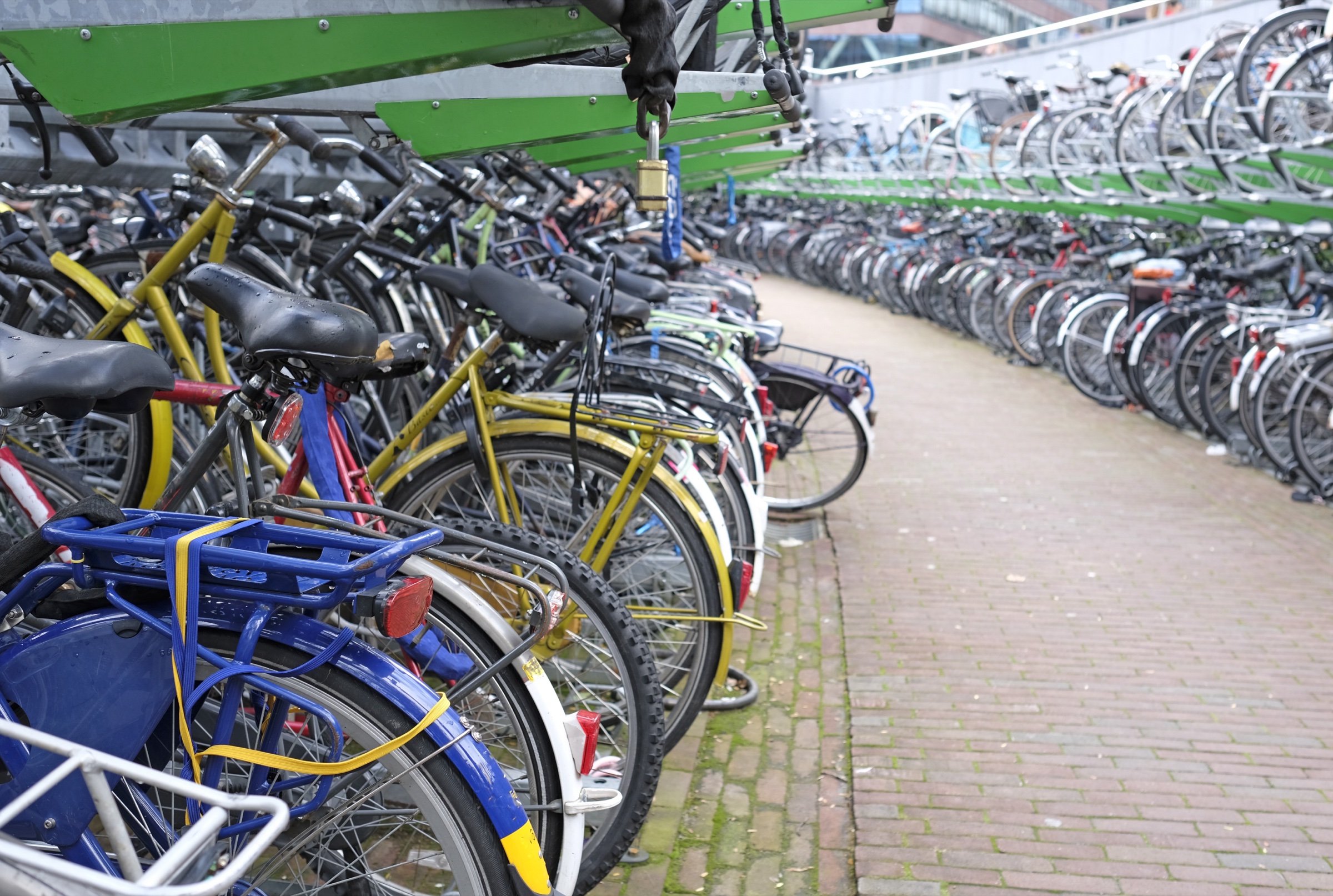
Your bike does not need to be new for any of this. For your health it makes no difference whether it is brand new or ten years old, as long as it rides well and fits you. How to spot a good used bike is in our guide to choosing a second-hand bike. Every bike on BikeFair is checked against stolen-bike registers before it is listed.
Got a bike in your shed that you no longer ride? Sell it, and someone else gets healthy on it.
Frequently asked questions
Is cycling healthy? Yes. A Dutch calculation from 2015 found that cycling adds about half a year to average life expectancy. That is an average from research, not a personal guarantee.
How many calories does an hour of cycling burn? At 75 kg, about 300 to 440 kcal at a relaxed pace on a city bike, about 600 at 20 km/h and about 750 at 25 km/h on a road bike.
How many kilometres a day of cycling is healthy? For the 150 minutes in the guidelines, a little over 20 minutes a day is enough. That is about 5 km at a relaxed city pace.
Is cycling good for your back? For most people, yes, as long as your bike is set up well. If pain does not go away, see your GP or a physiotherapist.
Is cycling good for your knees? It is a joint-friendly way to move. Set your saddle so that your knee is still bent 25 to 30 degrees at the bottom of the pedal stroke.
Does riding an e-bike count as exercise? Yes. E-cycling is at least moderate intensity exercise, less than a regular bike and more than walking.
Is cycling or walking better? Both count. Cycling is usually more intense per minute and fits more easily into your commute.